Sell gift cards online instantly — and why nobody can do it safely
Updated August 25, 2026 · Reviewed by Kirill Novikov, FlipGift founder
"Sell gift cards online instantly" is one of the most searched phrases in this market, and almost every site selling to you has put it in a headline. It is worth understanding what that headline is doing there, because it is not describing a payment method. It is a hook written for a search engine, and the model behind it cannot be made safe — not by us, not by anyone.
Here is the whole argument, in the order it actually breaks.
The trade everyone else asks you to make
Every buy-back site works the same way: you send the card's number and PIN, they check the balance, they pay you, and they resell the card to someone else.
That single step — handing over the code — is where the safety goes, and it is worth being precise about why. A gift card is a bearer instrument. It has no owner, no account holder and no password. Whoever knows the number and PIN can spend it, from anywhere, and the store will let them, because the store has no way to know they are not you.
So the moment the code is copied, two people can spend the same money. Only one of them can win.
Two disputes that cannot be settled — ever
The first one runs against the service. Suppose they really did pay you the instant you submitted the card. What stops you from going straight to the store and spending it? You already have the money. The card is still yours to spend, because you still know the code. Nothing stops you. Anyone who pays before checking is funding that, every day, at scale.
The second one runs against you, and it is the one nobody mentions. Say you are completely honest. You sell a $200 card, get paid, and never touch it again. The service resells it. The person who buys it drains it in ten minutes and then tells the service the card arrived empty.
Now the service has to decide who is lying. And it cannot:
- The store's records are the store's. A resale service has no access to the retailer's transaction data — it cannot pull up who redeemed what, where, or when.
- Even if it could, a balance that went to zero has no name attached to it. A gift card redemption is not a signed transaction. It is a code that was typed in.
- And the service has already paid you. Its only remaining move is to take the loss, refund the buyer, or come back and accuse you — with no evidence either way.
There is no arbiter here, because there is no evidence to arbitrate. That is not a company being careless. It is the model.
So what can a service actually do about it?
There are exactly four options, and every operator in this market is using some mix of them:
- Check the balance before paying. Sensible — and it is the step that makes "instant" impossible. This is why there is always a wait between your submission and your money.
- Hold the payout for a review window, so a drained card surfaces before the cash leaves. Also sensible. Also not instant.
- Pay you less. Every card that turns out to be empty is paid for by the cards that were not. The losses are inside the rate you are offered — you are covering them.
- Not pay at all. This is where the scams live: collect the code, promise the money, and simply never send it. The card is gone the same minute, and there is nobody to appeal to.
Options 1 and 2 kill the word "instant". Option 3 is a discount you did not choose. And the reason "instant" is such an effective headline is that it quietly promises the first two will be skipped — which, if it were true, would leave only option 4.
That is the risk of the phrase. Not that it is always a lie, but that the version of it which is genuinely instant is the version where nobody checks anything — and a service that checks nothing is not protecting you, it is deciding later whether to pay you.
What is actually instant
The quote. Enter a brand and a balance and any resale site prices it immediately. That part is real and worth using to compare offers.
The money is a different question, on every platform, and it always has a step in front of it.
The rule FlipGift is built on
The number and PIN are the money. They are not a description of the card, not a reference number, not a detail to paste into a form — they are the bearer credentials for a sum of cash. Once they exist in a second place, they are outside your control forever, and no policy, escrow or terms of service can bring them back.
So we built the marketplace so that they never move at all.
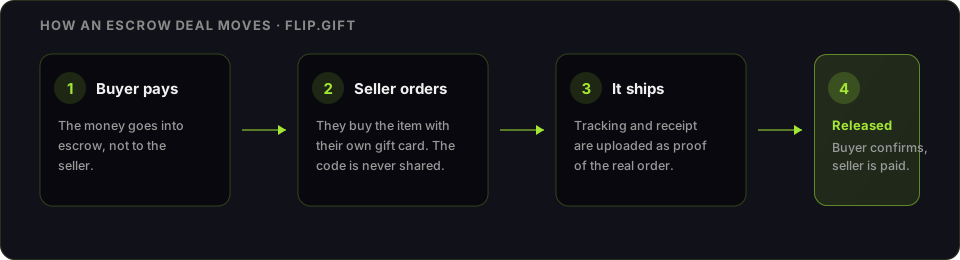
You keep the card. A buyer's money is locked into escrow first. You then go to the store yourself, pay for their order at the store's own checkout with your own card, and it ships to their verified address. When delivery is confirmed, escrow releases your money.
At no point does anyone ask for the number, the PIN, a photo of the card, or a balance screenshot. There is nothing to copy, nothing to drain, and nothing to argue about later.
How the escrow sale works, step by step · Why we never ask for the code
Why this one can be settled
Notice what changed about the evidence.
A drained balance cannot be attributed to anybody. A delivered parcel can. There is an order at the retailer, a receipt, a tracking number and a delivery confirmation — all of it visible to both sides, none of it dependent on trusting either. If something goes wrong, there is something real to look at.
That is the difference between a marketplace that can resolve a dispute and one that can only guess. It is also why escrow works here and could never work on a code handoff: you cannot escrow a secret that the other party has already memorised.
What this costs you, honestly
Speed. This is not instant and we are not going to pretend otherwise. You list a card, you wait for a buyer whose order fits it, you place that order, and it ships. If you need cash in the next hour, this is not the route — a buy-back site or a kiosk is, and you will pay for the speed in the rate and in the code you hand over.
What you get instead: you set your own discount, the card stays in your pocket until you spend it yourself, and there is no version of this where you are explaining to somebody that you did not drain a card you no longer control.
Comparing every route by payout, wait and risk? The full breakdown. We also looked at the biggest buy-back site in detail — what "legit" does and does not cover.
One route we refuse outright: card-for-card swapping. In any code trade the other side still knows your number and PIN and can drain the card later, and no platform can prevent it. The full reasoning.
If you are selling anywhere, on any site
- Check the balance yourself first — balance checkers for 140+ brands — so you know what the card is worth before anyone else can touch it.
- Treat "instant, no verification" as the warning it is. It is the one promise in this market that cannot be kept honestly.
- Never send a code to an individual. On a platform you at least have a counterparty; in a DM you have a stranger holding cash that used to be yours.
- One card, one platform. Submitting the same code twice is fraud even when it is an accident.
- Assume the handoff is final. There is no chargeback on a gift card code, no recall and no dispute button. Everything after it runs on somebody else's process.
Frequently asked questions
Can I really sell a gift card online and get paid instantly?
Why is handing over the card number and PIN unsafe even on a real site?
What happens if the person who buys my card says it was empty?
How to sell gift cards online instantly with no verification?
Where can I sell my gift cards for cash instantly?
Does FlipGift pay instantly?
Why do instant-payout options pay less?
Is it safe to sell gift cards online?
Compare FlipGift with other ways to sell
From the blog
How to Verify Gift Card Balance Before Trading a Card
Before you list, swap, or sell a gift card, confirm what's actually on it. Here's why balance checks matter and the three fastest ways to do one.
Can You Return Gift Cards? The Real Rules in 2026
Most stores treat gift cards as final-sale. But there are real exceptions — and if yours doesn’t qualify, you still have a way to get full value out.
What to Do With Unwanted Gift Cards: 6 Smart Options
Stuck with a card you'll never use? Here are six realistic options for unwanted gift cards, ranked by how much value you actually keep.