How to Get a Discount at Almost Any Online Store
Updated September 2, 2026 · Reviewed by Kirill Novikov, FlipGift founder
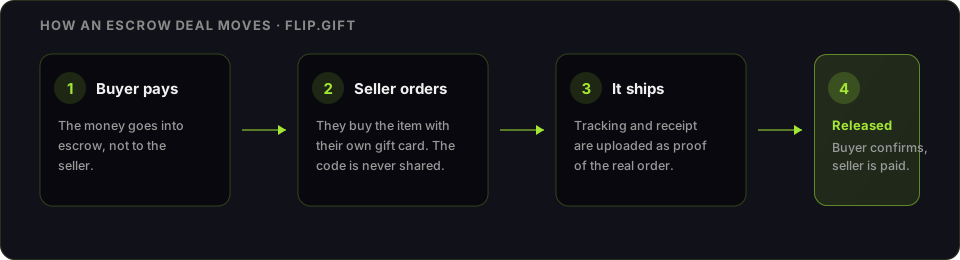
Coupons expire, cashback tops out at 1–5%, and sales never cover the thing you actually want. But there's a structural discount hiding in plain sight: millions of dollars of gift cards sit unused in drawers, and their owners will gladly spend that balance on your order for less than you'd pay the store. The hard part was always trust — and that's exactly what escrow solves.
The mechanics: buy the order, not a gift card
On FlipGift's escrow marketplace you don't buy a discounted gift card and hope it's real. You buy the item:
- Post what you want — a product link, the store price, your shipping address, and the minimum discount you'll accept (most buyers ask 8–40%).
- Your money goes into escrow — held by the platform. The seller can't touch it. You can cancel any time before fulfilment and it returns to your wallet.
- A verified card-holder places your order on the store's official site, using their own gift card, shipped to your address — with the order confirmation and a real carrier tracking number recorded as proof.
- You confirm delivery, then the money moves. Not before. If the item never ships, the escrow refunds you.
Why would anyone shop for you at a loss?
Because it's not a loss to them. A gift-card holder who cashes out through a resale site loses 15–40% of face value to the middleman. Fulfilling your order at a 10% discount loses them far less — so an unusable $200 Nike card becomes ~$180 of real money for them and ~$20 off for you. Both sides beat the resale middleman; that spread is the discount. It's the same economics behind invite-only "buying groups" in the points-and-miles world, opened up to a public marketplace with escrow instead of trust.
What it works for (and what it doesn't)
Anything orderable online and shippable from a supported store: sneakers, electronics, home goods, beauty, pet supplies — see the brand list, from Nike and Best Buy to Sephora, Home Depot and Chewy. It's not for digital codes, in-store pickup, or same-day needs — matching and shipping take the time a normal online order takes, sometimes a bit longer if no seller covers your store the moment you post.
The safety question, answered directly
"A stranger buys it with their gift card" is — rightly — a phrase that sets off scam alarms, because the informal version (Craigslist, DMs, wire-me-first) is a classic con. The difference here is that no step runs on trust: your payment sits with the platform, not the seller; the seller's proof (store confirmation + tracking to your verified address) is recorded; release requires your confirmation; and a dispute process with an arbiter covers the edge cases. The seller never learns your payment details, and you never touch their gift card. Read the full step-by-step escrow flow for exactly what happens at each stage.
Real math on a $300 order
Say a $300 standing desk, and you set a 12% minimum discount. A seller with a $350 store card accepts, places your order, ships it to you. You paid $264 plus a small platform fee — roughly $30 saved on an item that never goes on sale, with your money protected the whole way. Stack it with the store's own promotions when the seller orders, and the effective discount grows.
Comparing it with buying a discounted card? Where discounted gift cards come from.
Related guides
- Discounted gift cards: what the discount really costs you
- Online arbitrage: sourcing without a clearance aisle
- Retail arbitrage: where the margin actually comes from
- Buying from US stores from abroad: the real cost stack
- Pay with crypto for things that actually ship
- Discount gift cards: every way to pay less at 198 stores
Live seller offers, confirmed within the last week. Pick a store and paste what you want — your money stays in escrow until it arrives.
Frequently asked questions
Is this legal?
What if the seller just takes my money?
How big a discount can I realistically get?
Does it work with sales and coupon codes?
Why not just buy a discounted gift card myself?
From the blog
How to Verify Gift Card Balance Before Trading a Card
Before you list, swap, or sell a gift card, confirm what's actually on it. Here's why balance checks matter and the three fastest ways to do one.
Can You Return Gift Cards? The Real Rules in 2026
Most stores treat gift cards as final-sale. But there are real exceptions — and if yours doesn’t qualify, you still have a way to get full value out.
What to Do With Unwanted Gift Cards: 6 Smart Options
Stuck with a card you'll never use? Here are six realistic options for unwanted gift cards, ranked by how much value you actually keep.