Where to sell a gift card — every route, with the real math
Updated October 19, 2026 · Reviewed by Kirill Novikov, FlipGift founder
Every "sell your gift card" option is a trade between three things: how much value you keep, how fast you get paid, and how much risk you take. Most articles rank sites; this one ranks the models, because that’s what actually decides your payout. All numbers are the services' published rates, checked 1 August 2026 — run your own card through our payout calculator to compare.
How to sell a gift card safely, step by step
The route matters less than the order you do things in. This sequence is the same whichever option you pick:
- Check the balance first, at the issuer. Not at a third-party checker — at the brand's own page. Selling a card whose balance you have not confirmed is how disputes start, and every buyer will verify it anyway. Our balance guides link the official checker for 140+ brands.
- Write the number down, then decide the route. Compare what each model below actually pays for your brand — a Home Depot card and a niche boutique card land in completely different bands.
- Read the payout terms before you submit anything. Specifically: when the money moves, by what method, and what happens if the balance is later disputed. That is where the routes really differ.
- Never hand over the code before you are paid unless you have accepted that risk deliberately. On a buy-back site that is the deal; on escrow it never happens at all.
- Keep the card and the receipt until the money clears. A cleared payment, not a confirmation email, is the end of the transaction.
If a buyer asks you to move to WhatsApp or Telegram, pays with a screenshot, or wants a "release fee" before your payout, stop there. That is the fraud pattern, not a process quirk.
1. Instant buy-back sites (CardCash, ClipKard, GiftCash)
They buy your card outright and resell it. Payout: 50–92% of face value — the "up to 92%" headline is a ceiling — CardCash's live rates topped out at 87% (Costco) in September 2026 — and niche brands drift toward half. Speed: offer is instant, payment lands after verification (days). Risk: you hand over the number and PIN before you’re paid; rejected cards and post-sale balance disputes are the classic complaints.
2. Marketplaces (GCX/Raise, GameFlip)
You list the card; a buyer picks it up. Payout: your price minus the fees — 15% + $0.30 for a new GCX seller — usually netting 65–85% after the discount you offer to sell at all. Speed: days to weeks to sell, and GCX then holds a new seller's money for 14 days. Risk: the code changes hands; buyer disputes can claw back a sale after you thought it was done.
3. Kiosks and store trade-ins
Cash on the spot at a mall kiosk or trade-in at Target/Walmart programs. Payout: 40–75% — the steepest haircut anywhere. Speed: immediate, which is exactly what you’re paying for. Risk: low fraud risk, maximal value loss.
4. Selling to strangers (eBay, Facebook, Reddit)
Payout: potentially 85–95% — best gross numbers on paper. Risk: the highest, by far: chargebacks after the code is redeemed, fake payment screenshots, marketplace bans on gift card sales. The FTC’s fraud reports are full of exactly this pattern. Only for people who enjoy risk administration.
5. P2P escrow — sell the card’s value, keep the card (FlipGift)
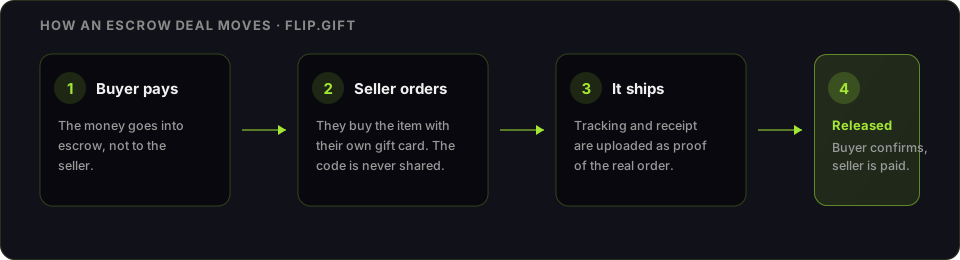
The newest model, and the only one where the code never leaves you. On FlipGift Escrow you don’t sell the card — you spend it on a real buyer’s order at that store. The buyer pre-paid a discounted price into escrow; when the delivery is confirmed, the money is released to you. Payout: typically 70–80% (you set the discount; platform fee is a flat 5% split with the buyer). Speed: as soon as a buyer order matches your store, then normal shipping. Risk: structurally the lowest — there is no code handoff to dispute, the platform verifies the delivery address against the order proof, and FlipGift stores no card numbers or PINs at all.
6. What about swapping instead of selling?
Card-for-card swapping used to be the "keep ~100%" answer on pages like this — including on FlipGift, which ran its own swap until July 2026. We retired it permanently, and the reason matters to anyone still considering the model anywhere: in a code-for-code trade, the previous owner still knows the card’s number and PIN and can drain it after the trade completes. No verification step can rule that out, because the risk lives after the exchange. If what you want is value rather than cash, sell through escrow and spend the proceeds where you like.
How fast each route actually pays
"Instant" on a landing page usually describes the offer, not the money. What the published terms say, checked 1 August 2026:
| Route | When the money moves | How |
|---|---|---|
| Kiosk | Immediately | Cash or voucher |
| Buy-back (CardCash) | 1–2 business days after approval | Check, ACH or PayPal; instantly on a virtual Mastercard |
| Buy-back (CardCookie) | 3–5 days after the card is validated | ACH, once bank details are verified |
| Marketplace (GCX) | When a buyer buys your listing, then a 14-day hold for new sellers | ACH only |
| Escrow (FlipGift) | When the buyer confirms delivery | Wallet, withdrawable |
Two things are worth reading twice. A marketplace listing can sit unsold indefinitely — an unsold card pays nothing, which is the hidden cost behind its better headline rate. And on every buy-back route the verification step happens after you have surrendered the code, which is why "how long does it take to pay" is the most common complaint on those platforms.
Our Safety Index scores each platform on exactly these points, and the situation-by-situation guide below narrows it to one.
Why "instant payment" offers are the scam pattern
The pitch is always the same shape: submit the card, get paid immediately. Read it once more and the problem shows itself — you are being paid before anyone has checked the card, while the card is still in your hands. Nothing stops the balance being spent in the meantime, and by the time the service lines up its own buyer the money can be gone. No honest business can carry that risk at scale, which is why the ones that promise it either do not pay, pay a fraction, or disappear.
The deeper problem is that the dispute it creates cannot be settled at all: a drained balance carries no name, and a resale service has no access to the store's transaction data. Why an instant buyout can never be safe.
The tells, in order of how often they appear:
- Payment promised before any balance verification.
- Contact moved off-platform — Telegram, WhatsApp, DMs — "for speed".
- A first small payout to build trust, then a request for a bigger card.
- No company details, no dispute process, no way to reach a human afterwards.
- Pressure: the rate expires in minutes.
Every legitimate buy-back route verifies first and pays after. That gap is not inefficiency — it is the only thing standing between the platform and fraud.
Picking by situation
- "I want the most money." Spend the card. If that is impossible, escrow on a store card returns the most of any cash route.
- "I need cash today." A buy-back site, accepting 60–85% and the code risk. Pick one with a payment-on-receipt policy rather than "after review".
- "I will not share the code." Escrow is the only route that never asks for it — sell a gift card without giving the code explains how the card stays in your wallet.
- "My card is digital-only." Visa, Roblox, PSN, Google Play: buy-back marketplaces, and read the platform comparison first.
The bottom line
Need cash today: buy-back site (accept ~70–85% on good brands) or a kiosk if it must be this hour. Need cash, hate risk: escrow — top-of-range payout and the code stays yours the whole time.
Need it today? Sell gift cards online instantly — and why nobody can do it safely.
Frequently asked questions
What's the highest-paying way to sell a gift card?
Why do all the buy-back sites pay less than face value?
Is it safe to give a site my card number and PIN?
How does selling through escrow actually work?
What if my card's brand isn't popular?
Where is the best place to sell a gift card?
How long does it take to get paid for a gift card?
What fee does FlipGift charge to sell a gift card?
Compare FlipGift with other ways to sell
From the blog
How to Verify Gift Card Balance Before Trading a Card
Before you list, swap, or sell a gift card, confirm what's actually on it. Here's why balance checks matter and the three fastest ways to do one.
Can You Return Gift Cards? The Real Rules in 2026
Most stores treat gift cards as final-sale. But there are real exceptions — and if yours doesn’t qualify, you still have a way to get full value out.
What to Do With Unwanted Gift Cards: 6 Smart Options
Stuck with a card you'll never use? Here are six realistic options for unwanted gift cards, ranked by how much value you actually keep.