Sell a Gift Card Without Giving Anyone the Code
Updated September 2, 2026 · Reviewed by Kirill Novikov, FlipGift founder
Every traditional way to sell a gift card has the same weak point: at some moment, you hand a stranger (or a company) the card number and PIN and hope the money comes. Resale sites pay 60–85% of face value after you submit the code. Peer-to-peer deals on Reddit or Facebook end with one side going first. And the "instant cash" sites that ask you to type in the number and PIN up front are how cards get drained — that's the single most common gift-card selling scam.
There is a way to turn a gift card into money where the code never leaves your hands at any point. Here's exactly how it works.
The escrow fulfilment model: you keep the card and shop with it
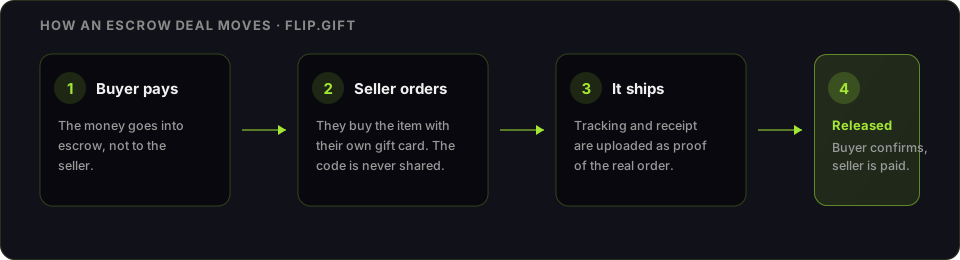
On FlipGift's escrow marketplace, you don't sell the card — you sell what the card can buy:
- List an offer. Pick the store your card is for, the most you'll spend on one order, and the discount you'll give a buyer (you choose the range). No balance proof, no code, no PIN — you commit only when you accept a specific order.
- Get matched with a buyer. Someone wants an item from that store at a discount. Their payment goes into escrow — held by the platform, not by them, not by you.
- Place the order yourself, with your own card. You order the buyer's item on the store's official site and ship it to their verified address. The card, the number, the PIN — all of it stays with you the entire time.
- Get paid from escrow. When the order is confirmed, the buyer's escrowed payment is released to your balance, and you withdraw it. A small security hold clears automatically after a short window.
Why this beats every code-handoff option
- Nothing to drain. A drained-card dispute is impossible by construction — nobody else ever has your code. This is the failure mode behind most "I sold my gift card and got scammed" stories, and it simply doesn't exist here.
- Better economics than resale sites. A resale buyer pays 60–85% of face value because they take on resale risk. Here you set your own discount — most sellers give 8–40% — so you keep more of the card's value.
- No account or region locks. Redeemed balances (Apple, Xbox, PSN, Google Play, Roblox) are locked to an account and can't be sold at all. With escrow fulfilment you can even use a balance you've already redeemed — you're spending it, not transferring it.
- No "go first" standoff. The buyer's money is committed to escrow before you spend a cent of your card.
What to watch out for elsewhere
Run the numbers side by side in our payout comparison — what a $100 card actually nets on each platform. And if you're comparing options, apply one test: does the site need your code before you get paid? If yes, you're trusting them completely. Legitimate resale buyers (CardCash, GiftCash, Raise's GCX) do operate this way and usually pay — minus their discount and fees — but the same flow is copied by scam sites that promise "instant cash," take the code, and vanish. The FTC's gift card scam guidance covers the pattern. A model where no code changes hands removes the question entirely.
What you can sell this way
Any brand with online ordering and shipping works — ~198 stores are live on the marketplace, from Walmart and Target to Nike, Sephora, Best Buy and Home Depot. (FlipGift once also offered a card-for-card swap as an alternative to cash; we retired it permanently in July 2026, because in any code-for-code trade the previous owner still knows the card's number and PIN and can drain it later — here's why swapping closed. Escrow, where no code ever moves, is now the whole product.)
Comparing routes? Where to sell a gift card, every route compared sets out payouts, wait times and risk for each one.
Frequently asked questions
Can I really sell a gift card without sending the code?
How much do I earn compared with a resale site?
Is escrow fulfilment a scam? It sounds like the stranger-pays-with-a-gift-card trick.
What if the buyer claims the item never arrived?
Can I sell a card I've already redeemed to my account?
Compare FlipGift with other ways to sell
From the blog
How to Verify Gift Card Balance Before Trading a Card
Before you list, swap, or sell a gift card, confirm what's actually on it. Here's why balance checks matter and the three fastest ways to do one.
Can You Return Gift Cards? The Real Rules in 2026
Most stores treat gift cards as final-sale. But there are real exceptions — and if yours doesn’t qualify, you still have a way to get full value out.
What to Do With Unwanted Gift Cards: 6 Smart Options
Stuck with a card you'll never use? Here are six realistic options for unwanted gift cards, ranked by how much value you actually keep.