CardCash Alternative: Get Paid Without Ever Handing Over the Code
Updated July 23, 2026 · Reviewed by the FlipGift escrow team
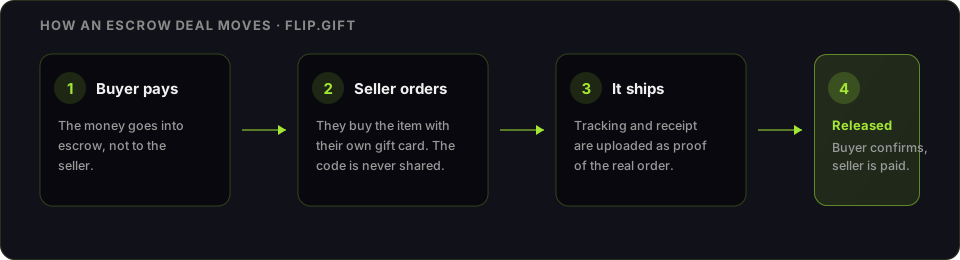
If you’re looking at CardCash to offload an unwanted gift card, it helps to know exactly what you’re trading away. CardCash pays you cash, but at a discount to the card’s value — and, like every buy-back service, it needs your card’s number and PIN before you’re finally paid. FlipGift is a different model: an escrow sale where the code never leaves your hands. You keep the card, spend it yourself on a real buyer’s order, and get paid from escrow when delivery confirms. Here’s a fair look at both so you can pick the right one.
How CardCash works
CardCash is a gift-card resale company that buys your card directly. You enter the card details, get an instant offer, and once the card is verified, CardCash pays you and resells the card itself. Checkable traits:
- You get cash, at a discount. CardCash advertises payouts of up to 92% of a card’s value, and is clear that the rate varies widely by brand — "up to" is a ceiling, not what every card gets.
- Payout methods: check by mail, ACH bank deposit, or PayPal. You can also choose to take another gift card instead of cash.
- Timing: payment is issued after verification (CardCash says typically within a couple of business days of approval); a mail-in card adds transit time.
- Why the discount exists: CardCash resells your card at a margin, so the gap between face value and your payout is how the business makes money.
How FlipGift is different
FlipGift doesn’t buy your card and never asks for its code. Instead, it matches you with a buyer who wants something from the store your card belongs to:
- The code never changes hands. You keep the card and redeem it yourself to place the buyer’s order — there’s nothing to surrender before you’re paid, and FlipGift stores no card numbers or PINs at all.
- Money waits in escrow. The buyer pre-pays a discounted price into escrow; it’s released to you when delivery is confirmed — not "after verification" of a code you’ve already given up.
- Flat, visible fee. 2.5% total, split between both sides — no hidden margin baked into an opaque offer.
- You set the discount. Sellers typically net 78–89% of face value, at or above the top of most buy-back ranges for everyday brands.
A note on our history: FlipGift also used to run a card-for-card swap, and we retired it permanently in July 2026 — in any code-for-code trade the previous owner still knows the number and PIN and can drain the card later, and no platform can prevent that. Here’s why we closed it. Escrow is the model we kept, because it’s the one where the code never moves.
CardCash vs FlipGift
| CardCash | FlipGift Escrow | |
|---|---|---|
| What you walk away with | Cash (or another card) | Cash |
| Do you hand over the code? | Yes, before final payment | Never — you redeem the card yourself |
| Fees / commission | Built into the discount (resale margin) | Flat 2.5%, split between buyer and seller |
| Typical value kept | Advertised up to 92%; varies widely by brand | Typically 78–89% (you set the discount) |
| When you’re paid | After verification of the surrendered code | From escrow, on confirmed delivery |
| Model | Direct buyer / reseller | Peer-to-peer escrow |
When CardCash is the better choice
Be honest with yourself about what you need. If you need cash this week and your brand draws a strong offer, an instant buy-back is faster: there’s no waiting for a buyer’s order to match your store. You accept the discount, the code handoff, and the possibility of a post-verification dispute in exchange for speed. If you can wait for a matching buyer — and would rather never expose the code at all — escrow typically nets more and removes the handoff risk entirely.
How a FlipGift escrow sale works
- List your card’s value — store and balance; the code stays with you and is never uploaded.
- A buyer’s order matches your store — they’ve pre-paid a below-retail price into escrow.
- You place the order with your own card and ship it to the buyer’s verified address.
- Delivery confirms — escrow releases your money, minus your half of the flat 2.5% fee.
Frequently asked questions
Is CardCash legit?
What are CardCash’s fees?
CardCash vs FlipGift — which is better?
Can I get full value for my gift card on CardCash?
Does FlipGift pay cash like CardCash?
From the blog
How to Verify Gift Card Balance Before Trading a Card
Before you list, swap, or sell a gift card, confirm what's actually on it. Here's why balance checks matter and the three fastest ways to do one.
Can You Return Gift Cards? The Real Rules in 2026
Most stores treat gift cards as final-sale. But there are real exceptions — and if yours doesn’t qualify, you still have a way to get full value out.
What to Do With Unwanted Gift Cards: 6 Smart Options
Stuck with a card you'll never use? Here are six realistic options for unwanted gift cards, ranked by how much value you actually keep.