Discounted Gift Cards: Get the Discount Without Buying a Risky Code
Updated September 30, 2026 · Reviewed by Kirill Novikov, FlipGift founder
If you’re looking for discounted gift cards, you want more value for your money. Here’s the fact most discount-card shoppers never hear: every resold gift-card code is still known to its previous owner. However carefully a marketplace verifies a card at sale time, the seller retains the number and PIN — in their head, their inbox, their photo roll — and can drain the balance after you’ve paid. That’s not a claim about any particular site’s honesty; it’s a structural feature of trading codes, and no platform can engineer it away. We know because we tried: FlipGift ran its own card-for-card swap and retired it permanently in July 2026 for exactly this reason (the full story).
Waiting for Black Friday? Black Friday gift card deals: what ran last year, and when this year's start
The escrow route: same discount, no code
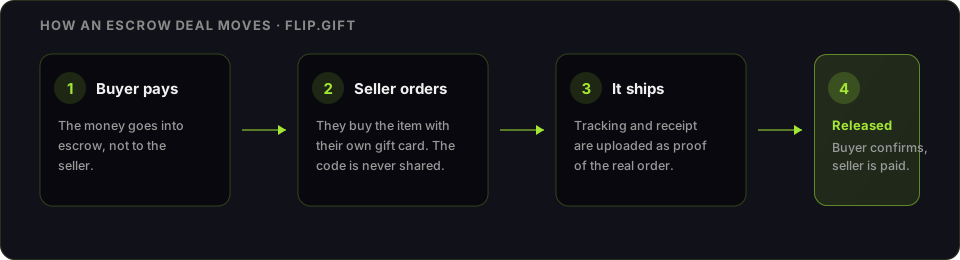
FlipGift’s answer is to move the discount from the code to the goods. With FlipGift discount shopping you don’t buy anyone’s card — you buy the thing you wanted the card for, below retail:
- Post the order — the product you want from one of ~198 supported stores, at the below-retail price you’re willing to pay.
- Your money goes into escrow — held by FlipGift, not sent to a stranger.
- A seller who holds that store’s gift card places your order using their own card, shipped to your address. Their card’s code never touches you — there’s nothing that can be drained out from under you.
- You confirm delivery — only then is the seller paid. The flat 5% fee is split between both sides.
The economics are the same ones that power discounted-card marketplaces — people holding unwanted cards accept less than face value to unlock the money — but the risk allocation is completely different: you never hold a code someone else knows, and your money isn’t released until your order arrives. Browse what’s available at the shop.
Holding an unwanted card? That’s the other side of this trade
The sellers funding these discounts are people with gift cards they’ll never use. If that’s you, sell the card’s value through escrow: you keep the card, redeem it yourself to fulfil a buyer’s order, and typically net 72–88% of face value — without ever sharing the number or PIN with anyone. FlipGift stores no card numbers or PINs at all.
"But marketplace X sells codes cheaper"
Sometimes true — resale marketplaces can list deep discounts, and the established ones do verify balances at listing time. The honest trade-off: verification proves the card was good then, not that it will still be good after the previous owner’s copy of the code has had a month to be used. Post-purchase drain is the classic complaint pattern on code marketplaces, and it’s the reason we won’t sell you a code at any discount. If you do buy one somewhere, spend it immediately — and see our risks guide for the full picture.
A quick example (illustrative)
Say a seller holds a $100 card for a store you shop. On a code marketplace, you might pay $85 for the code — and inherit the risk that it stops working next week. Through escrow, you order $100 worth of goods and pay, say, $85 into escrow; the seller ships using their card; you release the money when the box arrives. Same discount, but the failure mode "code drained after I paid" simply doesn’t exist, because no code ever changed hands. (Figures are illustrative; actual discounts vary by store and live seller supply.)
Shop below retail · How escrow works
Looking for the actual sources? Where to buy discounted gift cards covers the retail, resale and no-card routes.
Wondering whether the card can go stale? Do Amazon gift cards expire? — short answer no, but Amazon promotional credits do.
Related guides
Live seller offers, confirmed within the last week. Pick a store and paste what you want — your money stays in escrow until it arrives.
Frequently asked questions
Can I buy discounted gift cards on FlipGift?
How do I get the most value out of a gift card I don’t want?
How big is the discount from shopping through escrow?
Are discounted gift-card codes safe to buy?
Is escrow shopping safe?
From the blog
How to Verify Gift Card Balance Before Trading a Card
Before you list, swap, or sell a gift card, confirm what's actually on it. Here's why balance checks matter and the three fastest ways to do one.
Can You Return Gift Cards? The Real Rules in 2026
Most stores treat gift cards as final-sale. But there are real exceptions — and if yours doesn’t qualify, you still have a way to get full value out.
What to Do With Unwanted Gift Cards: 6 Smart Options
Stuck with a card you'll never use? Here are six realistic options for unwanted gift cards, ranked by how much value you actually keep.