Raise Alternative: Sell Your Card’s Value Without Handing Over the Code
Updated September 23, 2026 · Reviewed by Kirill Novikov, FlipGift founder
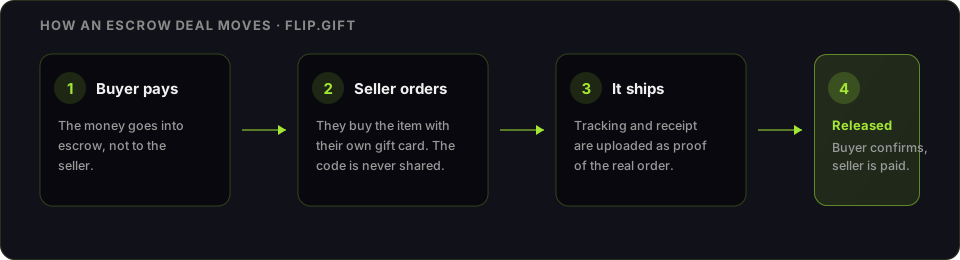
Raise was one of the best-known places to offload a gift card; since July 2024 its marketplace runs as GCX (gcx.app), while raise.com is now a separate cashback app. It’s still a marketplace, which means you list your card, wait for a buyer, pay a commission when it sells, and the buyer receives your card’s code. FlipGift takes a different path: an escrow marketplace where you keep the card, spend it yourself to fulfil a buyer’s order, and get paid from escrow on delivery — the code never leaves your hands. Here’s a fair comparison.
How Raise works
On Raise, you’re not selling to Raise — you’re selling to other buyers on its marketplace. Checkable traits:
- You list and set a price. You enter the card and choose a selling price, usually a discount off face value to attract buyers.
- Selling costs a commission plus a listing fee. New sellers pay 15% plus $0.30 per sold card; the commission falls to 10%, 7.5% and 7% as quarterly sales grow (GCX seller tiers, September 2026).
- You’re paid well after it sells. A buyer has to purchase your card first; then the money is held for a payout delay — 14 days for new sellers — and sent by ACH, the only payout method. You stay liable for the card for up to a year.
- The buyer gets your code. Like every resale marketplace, the product being delivered is the card’s number and PIN.
How FlipGift is different
On FlipGift’s escrow marketplace, you sell what the card can buy, not the card itself:
- The code stays with you — always. You place the buyer’s order at the store’s own checkout using your card, and ship to their verified address. FlipGift stores no card numbers or PINs at all.
- The buyer’s money is committed first. It sits in platform escrow before you spend a cent of your card, and is released to you on confirmed delivery.
- You set your own discount. Most sellers net 72–88% of face value in withdrawable cash — you control the trade-off between speed and rate.
- One flat fee. 5% of the deal, split between buyer and seller (~2.5% on your side) — no tiered commissions.
Raise vs FlipGift
| Raise | FlipGift | |
|---|---|---|
| What you walk away with | Cash | Cash |
| Model | Marketplace — your code is sold to a buyer | Escrow — you fulfil a buyer’s order, code stays with you |
| Fees / commission | Seller commission (tiered by volume) | Flat 5% split between sides |
| Code handoff | Yes — buyer receives the card | Never |
| Typical seller net | Your discounted price, minus commission | 72–88% of face value |
| When you’re paid | After a buyer purchases your listing | From escrow, on confirmed delivery |
When Raise is the better choice
If you want a paste-the-code sale, a marketplace like GCX is simpler: you list, it sells, and after the payout hold you’re paid — though you remain liable if a buyer later claims the card was bad. FlipGift asks more of you — you place the buyer’s order yourself and ship it — in exchange for keeping more of the value and never exposing the code. If your card’s store doesn’t ship physical goods, resale may also be the only route.
How a FlipGift escrow sale works
- List an offer — the store, your max order size, and the discount you’ll give. No code, no PIN, no balance upload.
- Get matched with a buyer — their payment locks into escrow, held by FlipGift.
- Place the order yourself — on the store’s official site, paid with your card, shipped to the buyer’s verified address, with an order screenshot and tracking as proof.
- Get paid from escrow — released on confirmed delivery, with a dispute process backed by your evidence.
(Historical note: FlipGift once also offered a card-for-card swap and retired it permanently in July 2026 — in any code trade the previous owner still knows the number and PIN and can drain the card later, a risk no platform can remove. Why swapping closed.)
Start an escrow sale — sell without sharing the code
Frequently asked questions
Is Raise legit?
What are Raise’s seller fees?
Raise vs FlipGift — which is better?
Do I have to hand over my card’s code on FlipGift like on Raise?
Didn’t FlipGift also do card-for-card swapping?
Compare FlipGift with other ways to sell
From the blog
How to Verify Gift Card Balance Before Trading a Card
Before you list, swap, or sell a gift card, confirm what's actually on it. Here's why balance checks matter and the three fastest ways to do one.
Can You Return Gift Cards? The Real Rules in 2026
Most stores treat gift cards as final-sale. But there are real exceptions — and if yours doesn’t qualify, you still have a way to get full value out.
What to Do With Unwanted Gift Cards: 6 Smart Options
Stuck with a card you'll never use? Here are six realistic options for unwanted gift cards, ranked by how much value you actually keep.