Paying with USDT: the network is the whole decision
Updated August 20, 2026 · Reviewed by Kirill Novikov, FlipGift founder
USDT is the stablecoin most people already hold, so the interesting question is never "can I pay with it" — it is which chain to send on. The coin is identical; the cost and the wait are not.
The five networks, measured
| Network | Time to credit | What sending costs the sender | Our payout minimum |
|---|---|---|---|
| BNB Chain | about 10 seconds | around $0.30 | $10 |
| Solana | about 15 seconds | fractions of a cent | $10 |
| Base | about 20 seconds | around $0.05 | $10 |
| Tron | about 1 minute | $1–3 without rented energy | $100 |
| Ethereum | about 2.5 minutes | $2–10 | $300 |
The credit times are measured on our own nodes rather than quoted from a docs page: they are block time multiplied by the confirmations we wait for — 15 on BNB Chain, 10 on Base, 12 on Ethereum, 20 on Tron, and Solana's finalized commitment.
The payout minimum in the last column is the honest version of "network fee". We set it from what a transfer on that chain actually costs, which is why sending out $10 is fine on Solana and pointless on Ethereum. Read the table upside down and it tells you where to send from: if you have a choice, Solana, Base and BNB Chain cost cents and land before you switch tabs.
Paying for a $150 order, step by step
- You post the order and get matched at, say, a 12% discount. The order costs $132, plus the 2.5% platform fee — $133.65 in total.
- You top up the wallet for that amount. The panel gives you an exact figure and an address, good for 30 minutes.
- You send exactly that figure in USDT. The amount is the identifier — it is how your transfer is matched to your account, so rounding it down or sending two smaller transfers breaks the match and turns an automatic credit into a support ticket.
- The balance appears when the network confirms — seconds on the fast chains.
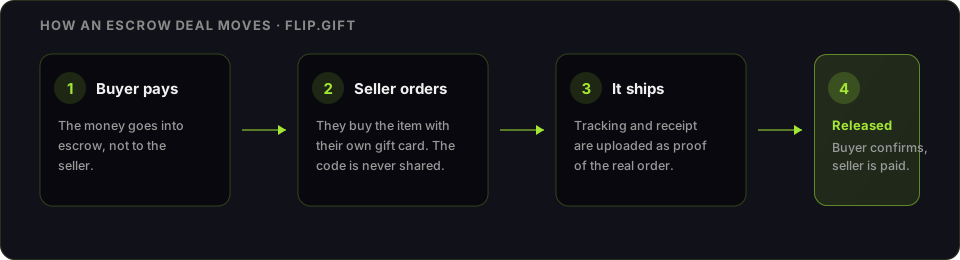
- That balance pays the discounted price into escrow, where it stays until you confirm the parcel arrived.
On Base or Solana, step 3 costs you less than the fee on step 1. On Ethereum it can cost more than the fee — which is the entire argument for picking a network deliberately.
When something goes sideways
- Paid after the invoice lapsed. The money is not lost: it sits in a 72-hour hold and support credits it by hand.
- Sent the wrong token, or the right token on a chain we do not watch. Anything outside the table above — bitcoin, bare ETH or BNB, an unlisted wrapper — cannot be credited automatically. Write to support before sending more.
- Sent a different amount than quoted. Same answer: it is matched manually, it just is not instant.
"USDT gift card" — what people usually mean
Most searches for a USDT gift card mean "let me turn USDT into something spendable". A card sold for USDT does that at face value: $100 of USDT buys $100 of store credit, and you carry the code. Here the same USDT buys the order below the store's price, and no code exists on your side at all. How the whole thing works →
USDC, DAI and PYUSD behave exactly the same way in the wallet — same escrow, same fee, same networks minus the two combinations that do not exist: no DAI on Tron or Solana, and PYUSD only on Ethereum.
Frequently asked questions
Which network is cheapest for sending USDT?
What happens if I send a slightly different amount?
Does the invoice expire?
Can I pay with USDT on a network you do not list?
From the blog
How to Verify Gift Card Balance Before Trading a Card
Before you list, swap, or sell a gift card, confirm what's actually on it. Here's why balance checks matter and the three fastest ways to do one.
Can You Return Gift Cards? The Real Rules in 2026
Most stores treat gift cards as final-sale. But there are real exceptions — and if yours doesn’t qualify, you still have a way to get full value out.
What to Do With Unwanted Gift Cards: 6 Smart Options
Stuck with a card you'll never use? Here are six realistic options for unwanted gift cards, ranked by how much value you actually keep.