Cardpool Shut Down: What Happened, and What to Use Instead
Updated September 23, 2026 · Reviewed by Kirill Novikov, FlipGift founder
If you are looking for Cardpool, the first thing to know is that it is gone. The gift-card exchange stopped operating in early 2021 and no longer buys cards, sells discounted ones, or stands behind anything it sold. So the useful question is not "Cardpool versus the rest" — it is what to do now, and what to do about any Cardpool card still in a drawer.
What happened to Cardpool
The company was winding down by January 2021. AARP, reporting on the closure at the time, quoted a company official saying they were "in the process of shutting it down, trying to complete all the pending transactions". The business was run out of Irving, Texas.
The explanation given was a collapse in revenue during the pandemic together with losses from fraud — cards bought with stolen credit cards. The complaint record complicates that story: AARP notes that complaints to the Better Business Bureau had been climbing since 2018, well before the pandemic, and that the company accumulated roughly 2,200 of them against an "F" rating.
Whatever the cause, the practical position today is simple. There is no Cardpool to sell to, no Cardpool to buy from, and no Cardpool guarantee behind a card you bought there.
If you still hold a card bought from Cardpool
Use it, and use it soon. A discounted card bought from an exchange is only as good as its remaining balance, and the protection that came with the purchase died with the company.
- Check the balance now, at the issuing brand's own site, not a third-party lookup.
- Spend it rather than saving it. The classic loss is a card kept "for later" that turns out to have been drained.
- If the balance is wrong, your recourse runs through the brand that issued the card, or through a chargeback with whatever payment method you used — not through Cardpool.
What the Cardpool gift card exchange actually was
Cardpool ran the standard exchange model: it bought unwanted gift cards from consumers at a discount and resold them, cheaper than face value, to shoppers. The seller got cash quickly and lost a slice of the value; the buyer got a discount and inherited a code whose history they could not see.
That second half is why the model keeps producing the same complaints wherever it operates. Once a code has been handed over, the original owner can still know it. Every exchange manages that risk with verification and a guarantee window, and the argument is always about what happens after the window closes.
Your options now
Two routes exist for an unwanted gift card, and they differ in exactly one respect that matters.
- Resale for cash, at a discount. CardCash and GiftCash buy your card outright; Raise lets you list it for a buyer. All of them pay a percentage of face value and all of them need the card's code before you are finally paid. Our breakdowns: CardCash, GiftCash, Raise.
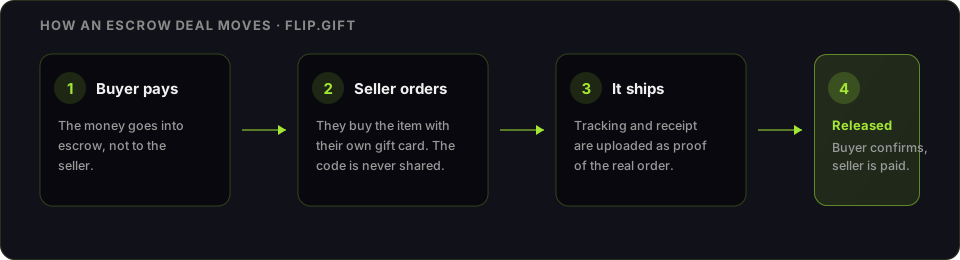
- Escrow sale, where the code never moves. You keep the card, use it yourself to fulfil a real buyer's pre-paid order, and are paid from escrow when delivery is confirmed — typically netting 72–88% of face value. How escrow works.
Worth knowing: FlipGift also ran a card-for-card swap and retired it permanently in July 2026. In any code-for-code trade the previous owner still knows the number and PIN and can drain the card later, and no platform can prevent that. It would be strange to argue that code handoffs are the problem and keep running one.
Cash sites vs escrow selling
| Resale sites (CardCash, GiftCash, Raise) | FlipGift Escrow | |
|---|---|---|
| What you walk away with | Cash | Cash |
| Code handoff | Required before final payment | Never — you keep and redeem the card |
| Fees / commission | Discount or commission applies | Flat 5%, split between both sides |
| Value retained | A percentage of face value, brand-dependent | Typically 72–88% |
| When you are paid | After verification, or after your listing sells | From escrow, on confirmed delivery |
| Model | Buyer / marketplace | Peer-to-peer escrow |
When a resale site is still the better choice
If you need cash this week and your brand draws a strong instant offer, a buy-back site is faster — there is no waiting for a buyer whose order matches your store. You accept the discount and the code handoff in exchange for speed. If you can wait for a match, escrow usually nets more and never exposes the code.
How an escrow sale works
- List your card's value — store and balance. The code stays with you and is never uploaded.
- A buyer's pre-paid order matches your store — their money is locked in escrow.
- You place the order with your own card and it ships to the buyer's verified address.
- Delivery confirms and escrow releases your money, minus your half of the flat 5% fee.
Sell without sharing the code · Compare payouts across platforms
Frequently asked questions
Is Cardpool still in business?
What happened to Cardpool?
What should I do with a gift card I bought from Cardpool?
What is the best Cardpool alternative?
Was Cardpool legit?
Does FlipGift pay cash like Cardpool used to?
Compare FlipGift with other ways to sell
From the blog
How to Verify Gift Card Balance Before Trading a Card
Before you list, swap, or sell a gift card, confirm what's actually on it. Here's why balance checks matter and the three fastest ways to do one.
Can You Return Gift Cards? The Real Rules in 2026
Most stores treat gift cards as final-sale. But there are real exceptions — and if yours doesn’t qualify, you still have a way to get full value out.
What to Do With Unwanted Gift Cards: 6 Smart Options
Stuck with a card you'll never use? Here are six realistic options for unwanted gift cards, ranked by how much value you actually keep.