Pay with crypto for things that actually ship
Updated October 15, 2026 · Reviewed by Kirill Novikov, FlipGift founder
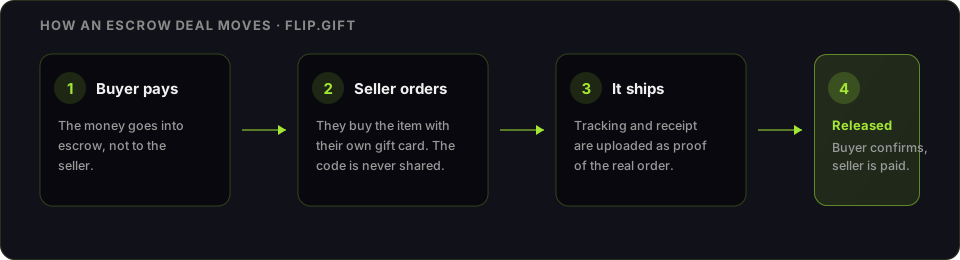
Most "pay with crypto" routes end at a gift card. You send coins, a site sends back a code worth exactly what you paid, and the saving is zero — you have converted stablecoins into store credit and taken on the job of guarding a code.
This is the other route. Your stablecoins pay for the order itself, placed at the store by someone who already holds credit there, at a price below what they pay.
What the money actually buys
You paste a product link from a US store. A seller holding gift-card balance at that store buys the item and ships it to your address. You pay less than they paid — the gap is their card's discount, shared with you — and FlipGift holds the payment in escrow until you confirm the parcel arrived.
None of that needs you to own a card, hold a code, or connect a bank. It needs a stablecoin balance and a US shipping address.
Coins and networks we credit
| Coin | Networks | Typical time to credit |
|---|---|---|
| USDT | Tron, Solana, BNB Chain, Base, Ethereum | 10 seconds to 2.5 minutes |
| USDC | Tron, Solana, BNB Chain, Base, Ethereum | 10 seconds to 2.5 minutes |
| DAI | Ethereum, BNB Chain, Base | 10 seconds to 2.5 minutes |
| PYUSD | Ethereum | about 2.5 minutes |
No bitcoin, and that is a decision rather than an oversight. We credit only the tokens we watch on chain, because a payment we cannot see is a payment we cannot credit. BTC, bare ETH and BNB sent to a deposit address are a loss, not a top-up. If you hold bitcoin, swap it for USDT or USDC first — every exchange and most wallets do it in a step.
Deposits run from $10 to $5,000, we charge nothing on them, and the exact amount you are quoted is what identifies your payment. An invoice is live for 30 minutes; pay after it lapses and the funds sit in a 72-hour hold where support matches them by hand instead of losing them. Which network to send on →
What paying this way costs
Two numbers, both shown before you commit:
- The discount — 8% to 40% off the store's price, set by whoever is offering balance for that store that day and by how large your order is.
- The platform fee — 5% of the deal, split evenly, so 2.5% on your side. Nothing on deposits, nothing per listing, no subscription.
A $200 order at a 15% discount costs $170, plus $2.13 in fee: $172.13 in stablecoins for what the store sells at $200.
Where this fits, and where it doesn't
- It ships to a US address. That is the one real-world fact the deal needs, because a parcel has to go somewhere. What else we ask for → If you are outside the US, that address is usually a forwarder's, and the cost stack works out like this.
- It is physical goods from stores that ship — a catalogue of 200+ US retailers, from Walmart and Amazon to Patagonia and Chewy.
- Order size follows live supply, not a marketing maximum: the largest single order the pool can absorb changes with the sellers who are online.
- It is not instant. A person places a real order at a real store, you get tracking, and the money leaves escrow after delivery is confirmed. How the hold works →
Stores people pay for this way
Amazon · Walmart · Target · Best Buy · Levi's · Old Navy · Marshalls · Wayfair · Chewy · Torrid
Each of those pages carries what that store actually costs through escrow, what ships free, and what people order there.
If you are comparing this to something else
Every other route for spending crypto belongs to one of three mechanisms, and each one has a page here saying plainly what it buys, what it costs and when it is the better tool than this.
Shops that sell you a code. You send coins, a code comes back at face value. Fast, global, and the only route that covers digital brands.
- Bitrefill — huge catalogue, instant codes, sats back on top of list price
- BitPay — a merchant gateway first, with a card marketplace attached
- eGifter — trading since 2012, points back that spend only at eGifter
- Coinsbee — thousands of brands, no account under EUR 1,000, face value
- Gyft — one of the first to take bitcoin, now inside Fiserv
- CoinGate — a licensed payment gateway first, a card shop second
- CoinCards — the widest coin list, Monero included, Canada-strong
- CryptoRefills — 6,600 products, no KYC, the same stablecoin rails as us
Apps that pay you back in bitcoin. You spend dollars at the full price and receive a percentage later. Good for accumulating coins; not a way to spend them.
- Lolli — bitcoin back at 10,000+ stores, paid after the return window
- Fold — sats on every swipe, locked for thirty days after posting
People trading with people. Escrow holds the coins — but a gift card is a secret, not an object, so it cannot hold the card.
- NoOnes — P2P with escrow (closed in August 2026), and what escrow cannot cover
- Paxful — the one that wound down, and why the flaw outlived it
- Purse.io — the one that did give discounts, and closed in 2020
The specifics, page by page
- Paying with USDT — and which network to send on
- Amazon and crypto: what actually works
- Crypto escrow: who holds the money and until what
- No ID upload: what we ask for and what we don't
Related guides
- Discounted gift cards: what the discount really costs you
- Where discounted gift cards actually come from
- How to get a discount at almost any online store
- Online arbitrage: sourcing without a clearance aisle
- Retail arbitrage: where the margin actually comes from
- Discount gift cards: every way to pay less at 198 stores
Frequently asked questions
Can I pay with bitcoin?
Do I need to already own crypto?
What am I actually buying — a gift card or the product?
How much can one order be?
Is this available outside the US?
From the blog
How to Verify Gift Card Balance Before Trading a Card
Before you list, swap, or sell a gift card, confirm what's actually on it. Here's why balance checks matter and the three fastest ways to do one.
Can You Return Gift Cards? The Real Rules in 2026
Most stores treat gift cards as final-sale. But there are real exceptions — and if yours doesn’t qualify, you still have a way to get full value out.
What to Do With Unwanted Gift Cards: 6 Smart Options
Stuck with a card you'll never use? Here are six realistic options for unwanted gift cards, ranked by how much value you actually keep.