Fold, and what 1.5% back is measured against
Updated September 1, 2026 · Reviewed by Kirill Novikov, FlipGift founder
Fold is a bitcoin-first personal finance app: a prepaid debit card that pays satoshis on spending, gift cards inside the app, automations that turn round-ups and recurring transfers into bitcoin buys, and — announced alongside its unified app release in February 2026 — a bitcoin rewards credit card earning 1.5% back on every swipe with a path to as much as 4%.
Is Fold legit? Yes. It is a US company with a public product, a listed parent, and a card programme run through the ordinary banking rails. Rewards behave the way card rewards behave: they show as pending at authorisation and are locked for thirty days after the transaction posts before they can be withdrawn.
What the reward is measured against
This is the part worth being precise about. You swipe, the merchant is paid in dollars, and you are charged the merchant's price. The bitcoin arrives afterwards, as a percentage of a purchase made at full retail.
So the question is not "is 1.5% good" — for a card, it is fine — but "what would the same purchase have cost if the price itself moved". On a $300 order, 1.5% back is $4.50 in bitcoin, available in thirty days. The same $300 order placed through someone holding store balance at 20% off costs $240, plus a 2.5% fee, and the $54 difference is yours immediately, in whatever you were already holding.
Gift cards bought inside Fold behave like gift cards bought anywhere: they cost face value, and the reward is a rebate on top.
Two mechanisms, opposite directions
Fold converts dollar spending into bitcoin. An escrowed proxy order converts stablecoins into goods at less than the goods cost. If you hold coins and want things, only one of those is pointed the right way.
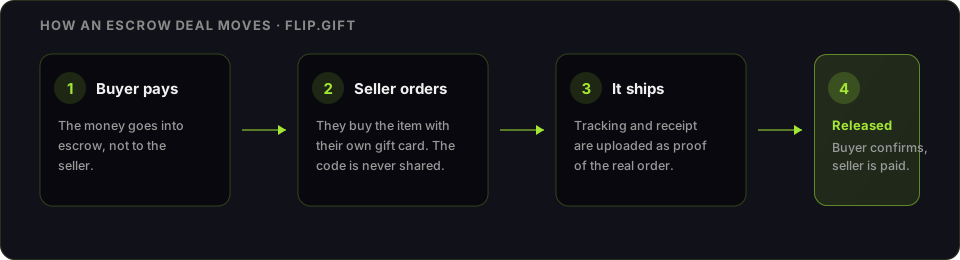
FlipGift is the second: post the product link, someone with balance at that store buys it and ships it to your address, and your USDT, USDC, DAI or PYUSD sits in escrow until you confirm the parcel arrived. 8–40% below the store's price, with the settled deals so far averaging 25% off.
| Fold | FlipGift | |
|---|---|---|
| What you pay with | A card, in dollars | USDT, USDC, DAI or PYUSD |
| Price of the goods | The store's price | 8–40% below the store's price |
| What comes back | Bitcoin — 1.5% base, up to 4% | Nothing back; the saving is the price |
| When | Locked 30 days after posting | Before you commit |
| Where it works | Anywhere the card is accepted | 200 US stores that ship goods |
| Protection | Card chargeback rules | Escrow until delivery is confirmed |
They are not really competitors. Fold is a good way to accumulate bitcoin out of ordinary spending; it is not a way to spend the bitcoin you already have. For that, this →
Facts about Fold above were checked on 1 September 2026 against the company's own site and its 4 February 2026 announcement.
Other routes, compared the same way
Bitrefill · BitPay · eGifter · CoinGate · Coinsbee · Gyft · CoinCards · CryptoRefills · NoOnes · Lolli · Purse.io · Paxful
One page per service, each saying where that service is the better tool than an escrowed order. How ours works →
Frequently asked questions
Is the Fold app legit?
Can I spend bitcoin I already hold with Fold?
Is 1.5% back the same as a 1.5% discount?
What does an escrowed order cost by comparison?
From the blog
How to Verify Gift Card Balance Before Trading a Card
Before you list, swap, or sell a gift card, confirm what's actually on it. Here's why balance checks matter and the three fastest ways to do one.
Can You Return Gift Cards? The Real Rules in 2026
Most stores treat gift cards as final-sale. But there are real exceptions — and if yours doesn’t qualify, you still have a way to get full value out.
What to Do With Unwanted Gift Cards: 6 Smart Options
Stuck with a card you'll never use? Here are six realistic options for unwanted gift cards, ranked by how much value you actually keep.