Buying from US stores from abroad, layer by layer
Updated September 1, 2026 · Reviewed by Kirill Novikov, FlipGift founder
Most US retailers either do not ship to your country or want a number for it that makes the whole exercise pointless. The workaround everybody converges on is the same: get a US address, have the store ship there, and forward the parcel yourself.
That works. It also means your landed cost is not one number but four, and it is worth knowing which of them you can actually move.
The four layers
| Layer | Typical size | Can you move it? |
|---|---|---|
| The item's US price | 100% of the base | Yes — and by the most |
| US sales tax | 0–10%, by destination | Yes, by choosing where the parcel lands |
| Forwarding | Varies with weight and consolidation | Somewhat — consolidation is the lever |
| Duty and import VAT | Set by your country | No |
Two of those four are usually treated as fixed and are not.
Sales tax is decided by the shipping address, not by you or the store. That is why forwarders advertise their warehouse states: MyUS runs its facility in a sales-tax-free zone in Florida and puts the saving at 7%; Stackry's warehouse is in Nashua, New Hampshire, a state with no sales tax at all. Nothing here is tax advice — it is simply how a destination-based tax works, and it is the reason two forwarders with identical shipping rates can land different totals.
The item's price is the layer nobody tries to move, because from outside the US it looks like a published number. It is not.
Why the item price is movable
Plenty of people in the US hold store credit they will not spend — a balance at a shop they do not use is worth less to them than something spendable. To a buyer who wants the goods, it is worth the goods. That gap is a real discount on the item itself, and it is the largest single line in the stack.
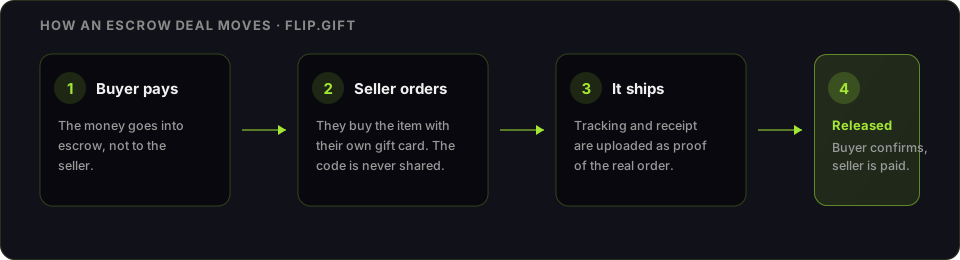
FlipGift is that trade with escrow in the middle. You post a product link from a US store; someone holding balance there places the order in their own account and ships it to your US address — including a forwarder's — and you pay 8–40% under the store's price. Settlement is in USDT, USDC, DAI or PYUSD, which matters more from outside the US than inside it: no US card, no bank, no currency conversion at somebody else's rate. The money sits in escrow until you confirm the parcel arrived at the warehouse; deals settled so far average 25% off.
What this does not do
Being straight about the edges, because they decide whether this fits you at all:
- We do not ship internationally. The parcel goes to a US address and the rest is between you and your forwarder. That is the whole reason the two services stack rather than compete. What each forwarder actually changes →
- A US address is required, and it must be real. State and ZIP are validated, and a forwarder's suite number is fine — the address check reads units, not the label on them.
- The product link must be the store's US site. a .com page; sellers pay with US gift cards, so an international storefront of the same brand cannot be bought.
- Returns are harder from a warehouse than from a home, and duty and import VAT in your country are yours. Neither of those changes because of how you paid.
- Order size follows live supply. The entry tier caps a deal at $2,000 and $4,000 a day; the largest single order the pool can absorb is $5,000. What is actually available today, store by store, is on the live market page.
If you are buying to resell
Most people doing this at any volume are. The stack above is your cost of goods, and the item line is where the margin is — the same argument, worked through with marketplace fees, is on retail arbitrage and online arbitrage.
See what the pool is offering today → · How paying in stablecoins works →
Related guides
Frequently asked questions
Can I buy from US stores if I do not live in the US?
Does a package forwarder's address work here?
How do I pay if I do not have a US card?
Do I still pay US sales tax?
Who pays import duty?
From the blog
How to Verify Gift Card Balance Before Trading a Card
Before you list, swap, or sell a gift card, confirm what's actually on it. Here's why balance checks matter and the three fastest ways to do one.
Can You Return Gift Cards? The Real Rules in 2026
Most stores treat gift cards as final-sale. But there are real exceptions — and if yours doesn’t qualify, you still have a way to get full value out.
What to Do With Unwanted Gift Cards: 6 Smart Options
Stuck with a card you'll never use? Here are six realistic options for unwanted gift cards, ranked by how much value you actually keep.