Where discounted gift cards actually come from
Page updated November 5, 2026 · Reviewed by Kirill Novikov, FlipGift founder
Three sources, and they are not equally good. Two are boring and safe; the third is where the discounts look biggest and the complaints come from.
Waiting for Black Friday? Black Friday gift card deals: what ran last year, and when this year's start
Shopping in December? Holiday gift card deals: what runs until Christmas, and the last day to buy
1. Retailers, at a small but reliable discount
The steadiest saving is a card bought new, at a shop, on promotion.
- Target takes 5% off gift cards when you pay with a Target Circle Card. It covers most third-party brands sold there — but not Target's own gift cards, not Visa, Mastercard or Amex prepaid cards, not sports-betting cards, and not Starbucks cards bought at an in-store Starbucks counter.
- Warehouse clubs — Sam's Club and BJ's — run brand eGift cards at roughly 3–5% under face, usually in larger denominations.
- Grocery chains run fuel-point promotions that can beat both, though the saving arrives as cents off a litre rather than off the card.
Expect 3–5%. Nobody in this tier is giving away 20%.
2. Resale marketplaces, at a bigger discount and a real risk
Sites like CardCash, GCX and CardCookie resell cards people sold to them, at roughly 5–20% off face depending on brand. The saving is genuine and so is the catch: you are buying a code that somebody else already knows.
Most of the time it works. When it does not, the balance is gone before you reach the till, and your recourse is the platform's guarantee window — 45 days at CardCash, 100 days for retail purchases at CardCookie. Read that window before you buy, and use the card quickly rather than saving it for later.
Comparing those listings by hand is the slow way to do it: CardBear ranks them for you — though the guarantee window still belongs to whichever marketplace wins, not to the comparison.
Our Safety Index grades each of these platforms on exactly that question, and the site-by-site comparison covers which ones still operate.
3. Getting the discount without buying a card at all
There is a third route that most "discounted gift cards" pages do not mention, because it is not a card: instead of buying a discounted code, you have someone who already holds a card place your order with it.
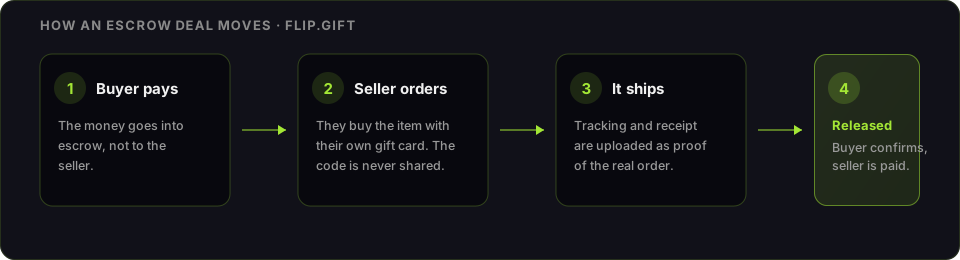
That is what FlipGift's escrow marketplace does. You paste a product link from any of 198 supported stores, name the discount you want, and a seller holding that store's card buys the item and ships it to you. Your money stays in escrow after buyer confirmation, the applicable automatic deadline, or a dispute decision. Live discounts run 8–40% off retail, which is deeper than the retail tier — and no code changes hands in either direction, so there is nothing to be drained.
The honest limits: it works only on shippable goods from those nearly 200 stores, and you wait for delivery rather than getting an instant code. If you need a digital code in five minutes, the resale marketplaces are your route.
Which one should you use?
- Buying a gift as a gift → retail tier. Small discount, no risk, a real card.
- Buying something specific for yourself → escrow. Deepest discount, no code risk, but it ships rather than arriving instantly.
- Need a code right now → resale marketplace. Check the guarantee window, spend it immediately, and never buy from a private seller.
Rules that save people money
- A discount above 25% on a mainstream brand is a warning, not a bargain.
- Never buy gift card codes from a social-media seller or a marketplace listing.
- Check the balance the moment you receive a code.
- Buying at 5% and stacking it with a sale beats hunting for a 20% code that turns out to be spent.
Buying rather than selling? Discounted gift cards: getting the discount without the code risk.
Buying to resell? The same discount is a cut in your cost of goods — worked through with marketplace fees on retail arbitrage and online arbitrage.
Related guides
Live seller offers, confirmed within the last week. Pick a store and paste what you want — your money stays in escrow until it arrives.
Frequently asked questions
Where can I buy discounted gift cards safely?
Are discounted gift cards from resale sites legit?
Does Target really give 5% off gift cards?
How do I get a discount without buying a gift card?
From the blog
How to Verify Gift Card Balance Before Trading a Card
Before you list, swap, or sell a gift card, confirm what's actually on it. Here's why balance checks matter and the three fastest ways to do one.
Can You Return Gift Cards? The Real Rules in 2026
Gift-card returns depend on the issuer, purchase terms and applicable law. Check those rules before choosing how to use an unwanted balance.
What to Do With Unwanted Gift Cards: 6 Smart Options
Stuck with a card you'll never use? Here are six realistic options for unwanted gift cards, ranked by how much value you actually keep.