Purse.io is gone. The model it proved isn't.
Updated September 1, 2026 · Reviewed by Kirill Novikov, FlipGift founder
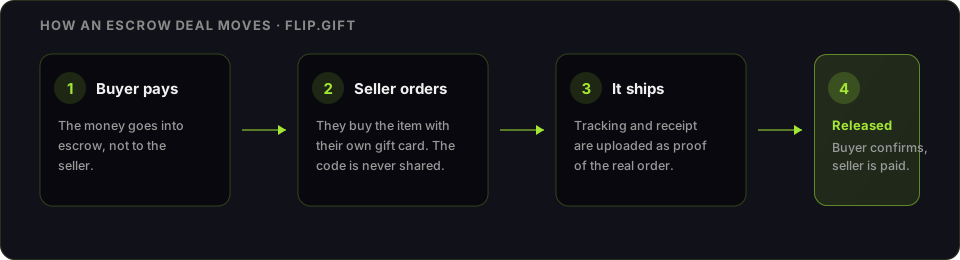
For six years, Purse.io did something no card shop has done since: it made crypto buy goods for less than the sticker price. Understanding exactly how is the fastest way to understand what to use now.
What it actually was
You posted an Amazon wish list and offered a discount. Somebody holding Amazon gift-card balance — people accumulate it constantly, from refunds, gifts and rewards — bought the items and had them shipped to you, and received your bitcoin in return. Purse held the coins in escrow until the parcel landed. The discount was whatever the two of you agreed, and the more patient you were, the deeper it went.
The value did not come from crypto. It came from the gap between what store credit is worth to somebody who cannot spend it and what it is worth to somebody who can.
When it closed
The shutdown was announced on 16 April 2020, new signups stopped the same day, the shop and earn functions were switched off a week later, and operations ceased on 26 June 2020 — an orderly wind-down with funds returned, not a collapse. The team publicly reconsidered after the response from users, and several parties enquired about acquiring it, but the closure went ahead.
What replaced it — and what didn't
The services people were pointed to afterwards are card shops: send crypto, receive a code, at face value. They are useful and they are fast, but they do not do the thing Purse did. The mechanism that produced the discount — a person with idle store balance, a buyer who wants goods, and an escrow between them — simply stopped existing at scale.
The same mechanism, rebuilt
FlipGift is that shape, with the details brought up to date:
| Purse.io | FlipGift | |
|---|---|---|
| What you pay with | BTC, later BCH | USDT, USDC, DAI, PYUSD |
| Where you shop | Amazon | 200+ US stores, Amazon among them |
| The discount | Set by how long you waited in the queue | Agreed up front, 8–40% |
| Escrow | Held the coins until delivery | Holds the payment until you confirm |
| Who buys | Someone with Amazon balance | Someone with balance at that store |
Why stablecoins rather than bitcoin. Two reasons, and both are practical. A parcel takes days, and a price agreed in a volatile asset is a different price by the time it arrives — that risk sat on somebody in the Purse model and it was rarely the platform. And we credit only what our own watcher sees on chain, which is USDT, USDC, DAI and PYUSD on five networks. If you hold BTC, one swap puts you back in the flow.
Where it is narrower: the US only, and physical goods that ship. Where it is wider: any store in the catalogue, not one retailer.
How to pay this way → · Amazon specifically → · What the escrow holds →
Other routes, compared the same way
Bitrefill · BitPay · eGifter · CoinGate · Coinsbee · Gyft · CoinCards · CryptoRefills · NoOnes · Lolli · Fold · Paxful
One page per service, each saying where that service is the better tool than an escrowed order. How ours works →
Frequently asked questions
What happened to Purse.io?
Is there a Purse.io alternative that still gives a discount?
Do I need bitcoin to use it?
Is it Amazon-only like Purse was?
From the blog
How to Verify Gift Card Balance Before Trading a Card
Before you list, swap, or sell a gift card, confirm what's actually on it. Here's why balance checks matter and the three fastest ways to do one.
Can You Return Gift Cards? The Real Rules in 2026
Most stores treat gift cards as final-sale. But there are real exceptions — and if yours doesn’t qualify, you still have a way to get full value out.
What to Do With Unwanted Gift Cards: 6 Smart Options
Stuck with a card you'll never use? Here are six realistic options for unwanted gift cards, ranked by how much value you actually keep.